Renovation
Websites for Renovation Contractors in Singapore
Renovation is the highest-consideration purchase on this list. A homeowner planning a $60,000 renovation is not going to pick their contractor from a Google ad. They browse for weeks. They visit multiple websites. They save portfolios to Pinterest boards.
The renovation website's job is not to get a call, it is to get someone to keep looking. To make them feel something. To make them imagine their home. That is a different brief from almost every other trade site I build.
This means the number one feature on a renovation website is not a contact form, it is the project gallery. If your photos are good and the layout shows them beautifully, customers will enquire. If your portfolio is buried or missing, they will leave in fifteen seconds. I build renovation websites to feel like the first page of an architecture magazine, visual, editorial, and aspirational.
How homeowners actually choose a renovation contractor in Singapore
The searches I see most often include "HDB renovation Singapore", "4-room BTO renovation ideas", "renovation contractor Singapore review", and "Japandi HDB renovation". These are inspiration searches, people collecting ideas before they are ready to talk.
Homeowners land on Google, Qanvast, and contractor websites at the same time. They flip between tabs, comparing what they see. Your website is competing with platforms built specifically to show renovation work, so the bar is high.
They do not read paragraphs about your company history. They look at photos. The decision happens visually: "I like their work" or "I do not." Everything else, your process, your team, your awards, only matters after the portfolio passes that first test.
Reviews matter second, but only after the portfolio passes. A homeowner will not read twenty five-star reviews if the project photos look dated or poorly shot. Quoting matters too: renovation customers want budget ranges early. Not an exact quote, just "HDB 4-room from $40,000" to know if you are in range.
Google, Qanvast, and Houzz set the visual standard your website is judged against. If your site looks dated next to a polished Houzz profile, you lose before they read a word. My web design packages for Singapore businesses include the kind of editorial layout renovation contractors need to compete on visuals.
Every renovation also involves electrical work, and homeowners researching contractors often check the electrician separately. I apply a different but equally deliberate approach on electrician websites, where credentials and licensing matter more than photography.
The renovation website mistakes that cost you enquiries
Portfolio hidden behind a navigation click
Your best projects should be on the homepage, immediately visible. A customer who has to click through to find your work will often leave before they get there.
Small, poorly displayed photos
Phone camera photos uploaded at low resolution, cropped awkwardly, all the same size. Renovation sells on visual impact, if the photos look amateur, the work looks amateur. Good photography displayed in a proper masonry grid makes everything better.
No budget guidance anywhere on the site
Customers about to spend $50,000–$100,000 want to know they are talking to the right person before they invest time in a consultation. Even a rough HDB versus condo versus landed price range stops the wrong enquiries and qualifies the right ones.
No design style categories
"Minimalist, Scandinavian, Contemporary, Japandi", customers search for these terms and they also use them to self-identify. If your portfolio is uncategorised, you are missing customers who would love your work if they could find it easily.
A "Book Now" CTA that does not fit the buying process
Renovation is a 6–12 month relationship. "Book Now" feels jarring. "Start a Conversation" or "Request a Consultation" matches how a renovation customer actually wants to engage.
What renovation homeowners are looking for when they browse
Visual proof comes first: real photos of real completed projects, not renders. Homeowners want to see kitchens, bathrooms, and living rooms that look like spaces they could live in, not computer-generated concepts.
Style categories that match their preferences matter. A customer who loves Japandi should find Japandi projects within seconds, not wade through industrial lofts and classical kitchens to find one relevant example.
Before and after transformations are some of the most engaging content on renovation websites because they show the contractor's problem-solving, not just their taste. A cramped HDB kitchen opened up into a bright galley tells a story a finished photo alone cannot.
Timeline expectations are a common question: how long will this take? A simple phase-by-phase guide, demolition, carpentry, tiling, handover, reduces uncertainty before they enquire.
Budget ranges by project type help homeowners self-qualify. HDB 4-room, condo, landed, each has a different price band. Showing ranges filters out mismatched enquiries and reassures the right customers.
Testimonials from homeowners with similar properties carry weight. A review from a 4-room BTO owner matters more to another BTO owner than a generic five-star comment.
Homeowners also want a sense of the contractor's personality and process, renovation is personal. The tone of your copy and the way you present your work should feel like an extension of how you actually work. I take a similar research-first approach on tuition centre websites, parents browse before enquiring too, though they look for schedules and fees rather than project photos.
What I build into renovation websites
Full-width editorial project gallery
A masonry or magazine-style grid that lets projects breathe, not a uniform 4-column thumbnail grid. Large format images. Hover overlays with project details.
Filterable portfolio by style and property type
Let customers find projects like theirs. Filters: Minimalist, Japandi, Contemporary, HDB, Condo, Landed. Each filter shows only relevant projects.
Before-and-after image sliders
Interactive sliders where customers drag to reveal the transformation. These are among the highest-engagement elements on any renovation website.
Design style guide section
Short descriptions of each design style you offer. Minimalist, Japandi, Scandinavian, Industrial. Helps customers identify their preference and confirms you can deliver it.
Investment guide (not a price list)
"HDB 4-room renovation: $40,000–$80,000" presented in an editorial format, not a price card. With context: what is included, what affects the final cost.
Project timeline section
A visual guide to how long a renovation takes, phase by phase. This answers one of the most common customer questions and reduces uncertainty before enquiry.
Consultation booking form
A form that asks: property type, property size, design style preference, budget range, and ideal timeline. This qualifies the enquiry and lets you prepare meaningfully for the first conversation.
To see these features in action, see demo sites for Singapore service businesses.
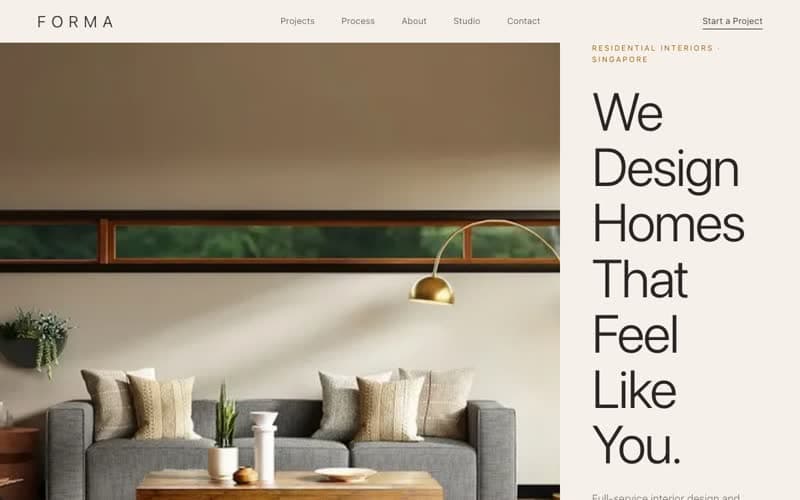
This is what a portfolio-first renovation website looks like
I built Forma Interiors as a working demo to show how I would approach a renovation contractor's website. If you want to talk through how this would work for your business, book a free website consultation.
Here is what to notice when you look at it:
- The full-screen editorial hero with a project image, no distracting widgets
- The masonry grid portfolio with hover project details
- The warm linen and charcoal colour palette, editorial, not corporate
- The before/after image sliders
- How the CTA says "Start a Conversation" rather than "Book Now"
Renovation website questions I get asked
At minimum: a project portfolio, a description of design styles you work in, a rough pricing guide by property type, a timeline section, and a consultation request form. The portfolio is the most critical, without it, there is nothing to persuade a browsing homeowner to get in touch. Everything else supports the portfolio.
Yes, it is the single most important page on a renovation website. Customers choose renovation contractors based on visual evidence almost entirely. A portfolio with 15–20 completed projects, filtered by style and property type, is worth more than any amount of written copy. If you do not have one yet, I can work with whatever photos you have and build it out as you complete more projects.
Usually a combination of friend referrals, platforms like Qanvast and Houzz, and Google searches. In all three cases, they will end up on your website at some point. What converts them is visual quality, good portfolio photos in a clean layout, followed by social proof from past clients, and a price range that tells them you are in their budget.
Not a price list, but a budget guide. Something like: "HDB 4-room renovation: $40,000–$80,000 depending on scope and materials." This is not a quote, it is a filter. It stops misaligned enquiries and reassures the right customers that you are within range. Every renovation contractor I have spoken to says this one change dramatically improves the quality of enquiries they receive.
Very, but your website is more important. Instagram gets you discovered; your website gets you trusted. I recommend having both, with your website displaying your best Instagram content and linking to the full feed. Customers who find you on Instagram will often visit your website before contacting you, that is where the conversion actually happens.
Ready to show your renovation work in the best possible light?
I build renovation websites that match the quality of the projects they show: editorial layouts, proper photo display, and a tone that feels like an interior design studio rather than a contractor's brochure.
Book a free 30-minute consultation. Bring your best project photos and I will show you how they would look in the Forma Interiors layout, and give you a fixed price to build your own version.
Also building websites for tuition centres and electrical contractors →